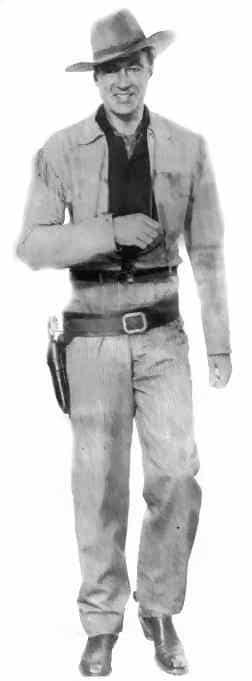
I knew Richard Anderson had an impressive acting resume, but I didn’t know how impressive a person he was until I met him Sunday night about an hour before the screening of The People Against O’Hara (1951). Nattily attired in a beige jacket with scarf, we started talking in the parking lot, continued while pausing in the Egyptian Theatre courtyard and then swept inside the lobby, still talking movies. The man isn’t just an actor; he’s a fan, a true cinephile. Anderson also is a history buff so we lapsed into a brief Civil War discussion in between stories about Spencer Tracy and Gary Cooper, the two actors that Richard admires above all others. Frankly, I was momentarily disappointed after glancing at my watch and noticing that the film was scheduled to begin in two minutes.
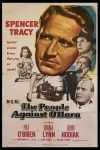
The People against O’Hara is a considerable film that really holds up. Spencer Tracy’s sole journey into noir (if one discounts Fury ) is an exceptionally well crafted picture with perhaps the best film actor of all time simply becoming the alcoholic attorney who takes on more than he can deal with. Superbly lensed by the maestro of noir cinematographers, John Alton, the dark wet streets of Culver City are indistinguishable from those of the Big Apple with superb supporting work by Diana Lynn, Pat O’Brien, John Hodiak, James Arness, Anderson, Eduardo Ciannelli (his role was a direct copy of the actual gangster “Socks” Lanza who ran the Fulton Fish Market in N.Y.C.with an iron hand), William Campbell, Emile Meyer and a plethora of familiar faces.
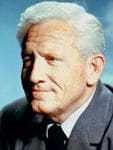
Richard’s discussion after the screening was a tour de force. As he signed with M*G*M just before the studio system began to disintegrate under the twin pressures of antitrust disvestiture and television , Anderson knew all of the great ones in the sunset of the Golden Age, making 29 movies in six years while under contract. Spencer Tracy personally selected Richard for O’Hara during a chance meeting in the Metro commissary. Even though Tracy coined the Cliff’s notes of acting: “Know your lines and don’t bump into the furniture”, Anderson revealed the great actor wasn’t above blowing his lines or adding dialogue, particularly under the smooth hand of John Sturges, who Richard averred was “…a great director”.
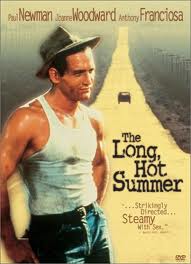
A half hour passed by at warp speed: Tracy, Sturges, John Alton, “A jolly Hungarian always having fun…”, Orson Welles magnificently talented at so young an age reduced to upstaging and gluttony in The Long Hot Summer. Paths of Glory and Stanley Kubrick with Richard revealing that he prevailed on Kubrick to film two versions of his reactions at the final firing squad scene. It just kept coming.
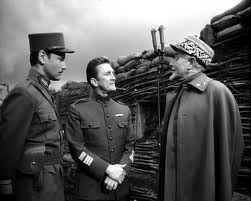
With an astute sense of timing, Richard wrapped up matters with a nice flourish. I felt like ordering takeout for the entire audience and letting him continue on for another hour or so, but there was a second feature that the customers paid to see.
A brief postscript on Gary Cooper who inspired Richard Anderson to try acting over six decades ago. When we were talking, I ventured that Cooper initially wasn’t much of an actor but through experience and hard work, made himself into a fine film performer. Richard responded with a story concerning Stanislavky’s first visit to Hollywood and when asked who was the best Western actor, the great pioneer of the Method responded, “The tall man is the best.” I didn’t need to inquire who the tall man was.